
Bayonne Neighbors by Block
Public sources answer different questions about the parcels surrounding a Bayonne address. NJGIN and Hudson County GIS show the mapped setting and parcel identifiers. The tax list adds the owner, mailing and situs fields, property class, value, and tax information. The Hudson County Register supplies recorded-document indexes for selected lots. Voter material may confirm limited registration information under state rules, but the research did not establish a public street-browse tool or a current ZIP-filtered file. Library directories can help with past occupants, while the city directory is a contact route for civic groups rather than a household roster.
| Source | What It Shows About a Block | Access |
|---|---|---|
| NJGIN / Hudson GIS | Adjacent parcel geometry, block and lot, and published map layers | Public dynamic maps; parcel click details can vary |
| Bayonne tax list | Owner, mailing and situs fields, class, values, and taxes by parcel | Official PDF or Tax Assessment office |
| Hudson County Register | Recorded parties, instruments, and legal descriptions for selected lots | AcclaimWeb or public search room |
| Election sources | Registration information subject to public fields and redactions | Official lookup or a county request, subject to law |
| Library directories | Historic occupants and address context for dated years | Reference, digitized material, or in-library collections |
A title holder is not automatically a current resident. Tax correspondence can go to a business, estate, representative, or another address. A parcel is a land record, not a census of every person connected with the building. That distinction keeps a block search honest and reduces accidental assumptions about Bayonne neighbors.
Map a Bayonne Neighbor Block
Start with a physical address, not a name. The official parcel workflow is a deliberate walk across the immediate Bayonne block: identify the target lot, pan along the street segment, and open the surrounding parcels one at a time. The research did not verify a dedicated adjacent-parcel, buffer, or radius control in either viewer, so do not claim that an automated neighbor ring exists. Manual map review and the block-and-lot key are the documented route.
- Search the target in NJGIN by address, or narrow first by Hudson County, Bayonne, block, and lot.
- Confirm the selected parcel’s physical shape, situs, block, and lot before moving across the same street segment.
- Click each surrounding parcel and record only the public parcel key and situs. Map geometry provides location context, not a surveyed boundary.
- Check the same block and lot in the Bayonne tax list, then use AcclaimWeb’s legal-description mode if recorded ownership history matters.
- For a complete named-street trail instead of an immediate-block check, use the Bayonne street directory.
Keep owner, mailing, and situs fields separate. The map locates land, the tax roll ties public tax fields to that land, and a deed index can confirm recorded parties. This process does not identify non-owner household members and should not be used to infer them.
NJGIN for Bayonne Neighbors
NJGIN Property Explorer is the statewide gateway for Bayonne parcel research. Its documented inputs are address, county, municipality, block, and lot. Choose Hudson County and Bayonne when those filters help, then normalize simple address variations such as Avenue and Av if an initial search fails. The returned parcel identifier can bridge map context to the city tax list and to the Register’s legal-description search.
The NJGIN Property Explorer source shows the Bayonne search concept and the state’s data limitations.
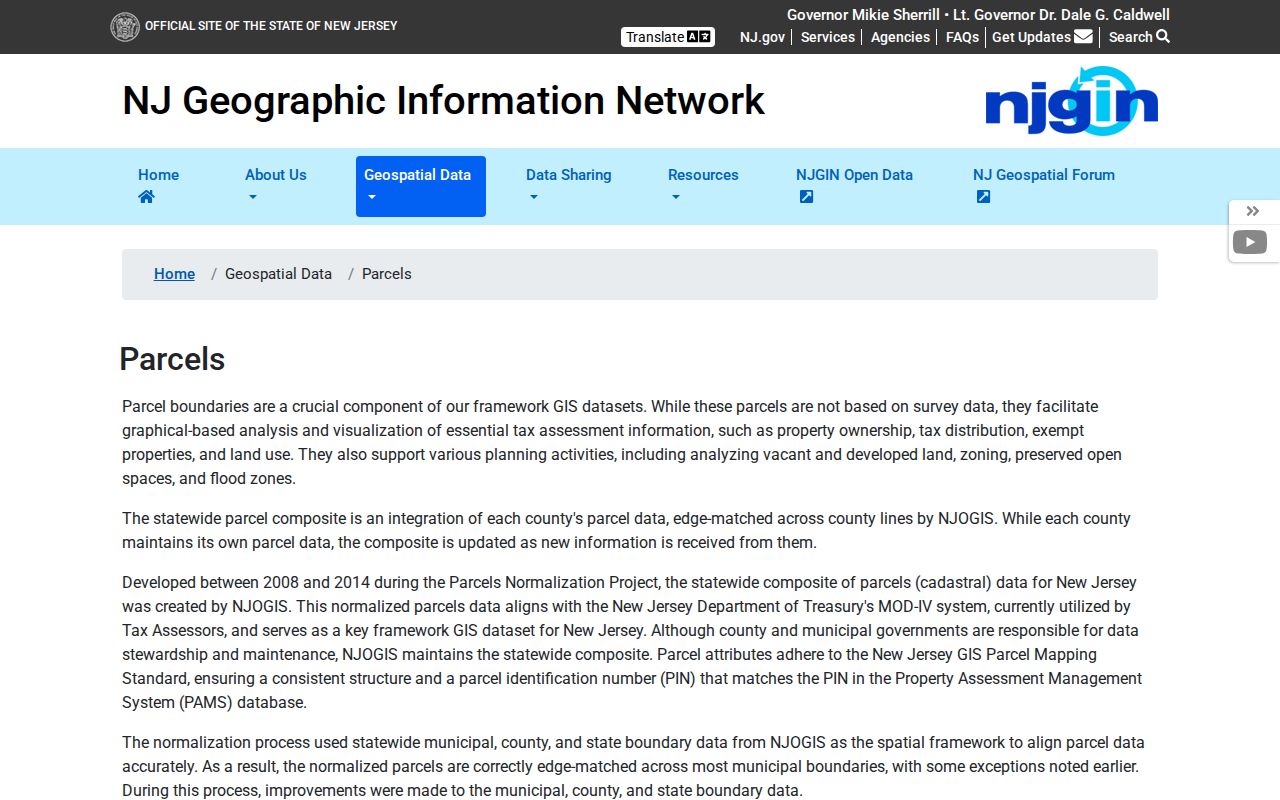
NJGIN notes that its parcels are not surveys or legal boundaries, that source agencies control currency, and that protected owner names are redacted under Daniel’s Law. Treat a redaction as a protection, not a problem to work around.
Hudson GIS for Bayonne Neighbors
The Hudson County GIS gateway is a second public map route for examining the Bayonne street segment around a parcel. Its current viewer can provide geometry and locally published zoning, flood, or district context. The source capture did not document the live layer list, popup fields, or a dedicated nearby-parcel tool. Use the current map to see what is published, then corroborate a parcel question with the city tax office or Register instead of relying on a line on the screen.
The captured Hudson County GIS source is the county-level companion to NJGIN.
Use the county map to compare the parcels immediately around an address, then keep the block and lot as the durable reference when checking another public record. That avoids treating a map label as a conclusion about ownership or residence.
Bayonne Neighbor Parcel Checks
The Bayonne Tax Assessment route leads to city tax maps and tax-list material. A tax-list row includes block, lot, qualifier, account number, land and building description, class, owner, owner mailing street and city, property location, ZIP, assessed values, exemptions, deductions, and taxes. It is useful for separating the parcel’s physical address from the address that receives tax mail. A homestead or exemption field is a tax classification, not proof that a named person lives there.
For a recorded transfer trail, use the Hudson County Register AcclaimWeb index. Search the Bayonne legal description by block and lot, then compare party names, instrument number, book and page, document type, recording date, and consideration. A mortgage, lien, or lis pendens is not a deed. If an online record ends before the needed period, the Register’s public search room has deeds, mortgages, filed maps, and indexes; the official online cutoff year was not found.
- Block and lot
- Tax-map identifiers that distinguish a Bayonne parcel and help match it to recorded legal-description searches.
- Mailing address
- The address used for tax correspondence. It may not be the property’s physical location or a current resident’s address.
- Situs
- The physical property location shown in the tax material. It anchors map and street research.
- Legal description
- The land description in recorded documents. It is the preferred key when an address has changed or is ambiguous.
Bayonne Neighbor Voter Limits
New Jersey voter information can help confirm a specific registration question, but it is not a public block roster. The research did not verify a street-browse mode in the official voter search, nor did it locate the current Hudson County full-file request form, price, delivery format, or ZIP-filter capability. Exact matching can fail when a name uses hyphens, spaces, a middle initial, or a married-name variant. A non-match is not proof that a person is not registered or no longer lives nearby.
Public election material can be subject to N.J.S.A. 19:31-1 and related provisions, OPRA, redactions, and confidentiality programs. Signatures, Social Security numbers, driver-license or non-driver ID numbers, and some date-of-birth details are protected. The New Jersey county election officials directory identifies the Hudson Commissioner of Registration, County Clerk, and Board of Elections contacts for a narrow, lawful question about access.
Note: Ask for the smallest non-exempt election record needed, because a broad request can expose more information than a block question requires.
Bayonne Community Contact Routes
Bayonne has public civic contact routes, but the researched sources do not supply a complete residential-neighborhood association or HOA directory. The city directory is useful for organizations such as the Bayonne Chamber of Commerce, VFW Post 226 Veterans Museum, and UEZ/SID. It is an umbrella directory, not a list of the people on a block. The Library’s vertical files also include Concerned Citizens of Bayonne, with a 1970 onward subject trail that can lead to public meeting material or clippings.
| Public contact route | Verified fact | Appropriate use |
|---|---|---|
| Bayonne city directory | Lists civic, veterans, business, and community organizations, including Chamber, VFW, and UEZ/SID entries. | Find a published organization contact, not a neighbor roster. |
| NJ LGCCC registered list | Lists Bayonne Heritage Association Inc. at 166 Broadway and Bayonne Fire Canteen at 289 Avenue A in the researched entry. | Confirm registered-organization context; it does not establish residential membership. |
| Bayonne City Clerk | City block-party rules contemplate a non-profit block association registered with the Clerk. | Ask about the registration process or a public record, not private participant information. |
| Bayonne Library Reference | Reference collections include city directories, maps, obituaries, local newspapers, and historical materials. | Research a dated address or civic-history question. |
Public events and published contacts are the proper community layer. No verified public congregation, block-watch, HOA membership, or civic-club roster was located, so those lists should not be treated as available records.
Bayonne Neighbor Association Gap
Bayonne’s block-party ordinance and July 2024 Council minutes show that a non-profit block association registered with the City Clerk can sponsor a block party. The rule permits up to two applications a year for Saturday or Sunday events from May through October, noon to 6 p.m. That verifies a municipal registration concept. It does not create or imply a citywide public directory of associations, their leaders, members, or addresses.
This is an important records limit for Bayonne neighbors. A community group may exist without a public roster, while an organization in a city or LGCCC listing may have no connection to a particular street. Use a published organization contact or City Clerk records process when it fits the question. Do not seek private membership lists or try to fill the official inventory gap with unverified directory claims.
Bayonne Neighbor Source Comparison
Official and commercial sources serve different purposes. The official parcel, tax, and deed trail is traceable to a public custodian and can be checked against the original field or document. Commercial neighbor-lookup categories may combine property, voter, court, broker, and other data. They can merge similar people, retain stale information, or present relatives and associates without explaining the source. Neither category identifies every Bayonne neighbor, but the official trail makes it easier to verify what a result actually means.
| Official Bayonne records | Commercial neighbor-lookup category |
|---|---|
| Source trail | Map, tax list, Register index, city office, or library collection can be identified and revisited. |
| Typical limits | Shows parcel or recorded-party evidence, not every person tied to a building. |
| Compilation risk | Can combine sources, carry stale data, or join similar names and addresses without clear provenance. |
| Best practice | Verify a public fact with its custodian and avoid using compiled details to make claims about a person. |
Use source labels as part of every Bayonne block note. Record the date checked, whether the result came from a map, tax list, deed index, or library record, and what it actually confirms. That is more useful than a longer but untraceable list of names.
Bayonne Neighbor Privacy Limits
Some Bayonne address information is intentionally unavailable. New Jersey’s Address Confidentiality Program supplies a substitute address and mail forwarding for eligible people facing serious safety concerns. Daniel’s Law requires redaction of covered people’s residential addresses and unpublished telephone numbers from government sites after approval, and NJGIN specifically notes protected owner-name redactions. Utility and delivery records are not a public substitute for a parcel or deed record. A missing result can be a privacy protection rather than a data error.
DCA reported more than 10,000 covered people protected by Daniel’s Law in 2025. That continuing redaction work means an older public-facing record may differ from a current parcel display. Do not attempt to reconstruct, infer, or publish a protected address through other data points. OPRA can provide public, non-exempt records, but it does not override ACP, Daniel’s Law, sealed or expunged matters, or other confidentiality rules.
Lawful use. Use Bayonne neighbor sources for a specific personal, civic, property, or historical question. Using public information to watch, harass, intimidate, or harm another person is prohibited and can violate New Jersey law.