
Bayonne Resident Records Coverage
A Bayonne resident lookup is not one master search. Property, voter, court, vital, probate, business, and library sources answer different questions and have different access limits. Start with the source that matches the question, then use a second independent attribute before deciding that two same-name records belong to the same person. A current legal owner is not a list of occupants, and a historical directory entry is not proof of a current address.
| Record | What It Confirms | Where | Access |
|---|---|---|---|
| Tax roll or GIS | Named legal owner, parcel, situs, mailing address, class, and value | Bayonne Tax Assessment; NJGIN or Hudson GIS | Public tax list/map; owner is not every occupant and protected names can redact |
| Recorded document | Party role, legal description, recording date, and ownership transaction | Hudson Register AcclaimWeb | Public index; image, copy, and fee rules vary; online cutoff was not located |
| Voter lookup | Registration status and geography, with fields varying by access route | New Jersey Voter Search | Protected identifiers and signatures are withheld; live field labels were not captured |
| Court case jacket | Party, venue, docket, caption, status, or disposition | New Jersey Courts, Municipal Court, or PACER | Restricted, sealed, juvenile, and family material is omitted; PACER has fees |
| Vital record | Event fact or family relationship | NJDOH, local registrar, or State Archives | Current confidentiality and eligibility rules apply; state fee schedule is listed by NJDOH |
| Probate | Executor, heir, will, estate date, or estate address | Hudson County Surrogate | Office or archive route; online coverage was not verified |
| Directory or yearbook | Historic address, spouse, occupation, class, or organization tie | Bayonne Library, State Library, or digitized directory | Historical evidence, not current proof; reference and library restrictions can apply |
Use the property and deed path when the question concerns an owner or parcel. Use the voter route only to check registration information, not as a household roster. Use the library's directory, census, and obituary material for a former resident. The Bayonne city directory collections provide the deeper historical shelf when an old address is the starting point.
Defining a Bayonne Resident Search
Write down the narrow question before searching. “Was this person the legal owner?” calls for the tax list, block and lot, and recorded document. “Was this person a historic occupant?” calls for a directory paired with census or obituary evidence. “Did this person appear in a court matter?” calls for a docket and venue, not an assumption that a name hit establishes identity or present residence.
Normalize the name as well. Keep the full spelling, middle initial, suffix, former or married name, alternate spelling, Bayonne address, and relevant date. The public voter hints specifically warn that hyphens, spaces, middle initials, and married-name variants can cause an exact-match failure. A no-match should therefore be recorded as a search result, not as proof that registration or residence never existed.
Bayonne's tax material makes a similar distinction: the owner mailing address and the property location are separate fields. An out-of-city mailing address can be accurate for correspondence while the situs identifies the Bayonne parcel. Keep both fields with the block and lot when verifying an owner.
Verifying a Bayonne Resident Record
Use a two-attribute check for a single person. The safest path begins with the least-sensitive source that answers the question, then compares independently recorded details. A court result can be narrowed by venue, docket, middle initial, date, or an address in the underlying file. A property result can be compared against block and lot, the legal description, and the recorded buyer or seller. None of those sources proves every household member.
- State the question and collect the person's full name, a known Bayonne address or date, and spelling variants.
- For a property question, compare the tax-list owner, mailing address, situs, block and lot before opening the deed index.
- Search the relevant name portal with variants, preserving the venue, date, or record identifier rather than a name alone.
- Confirm two independent attributes, such as name plus block and lot, spouse plus address, or docket venue plus an underlying-file detail.
- If an official portal is silent, ask the correct custodian what identifier is needed, then make a narrow written request for a public, non-exempt record.
- Docket
- A court's identifying number for a case. It connects the parties and venue to the case jacket or clerk file.
- Index versus image
- An index lists identifying fields so a record can be found. An image is the underlying document or scan, and access can have separate rules.
- Certified copy
- A copy issued or authenticated by the custodian for an authorized purpose. It is different from an index entry or an informal printout.
Note: Preserve the search date and the exact attributes used because public records and portal displays can change.
Bayonne Court Record Search Fields
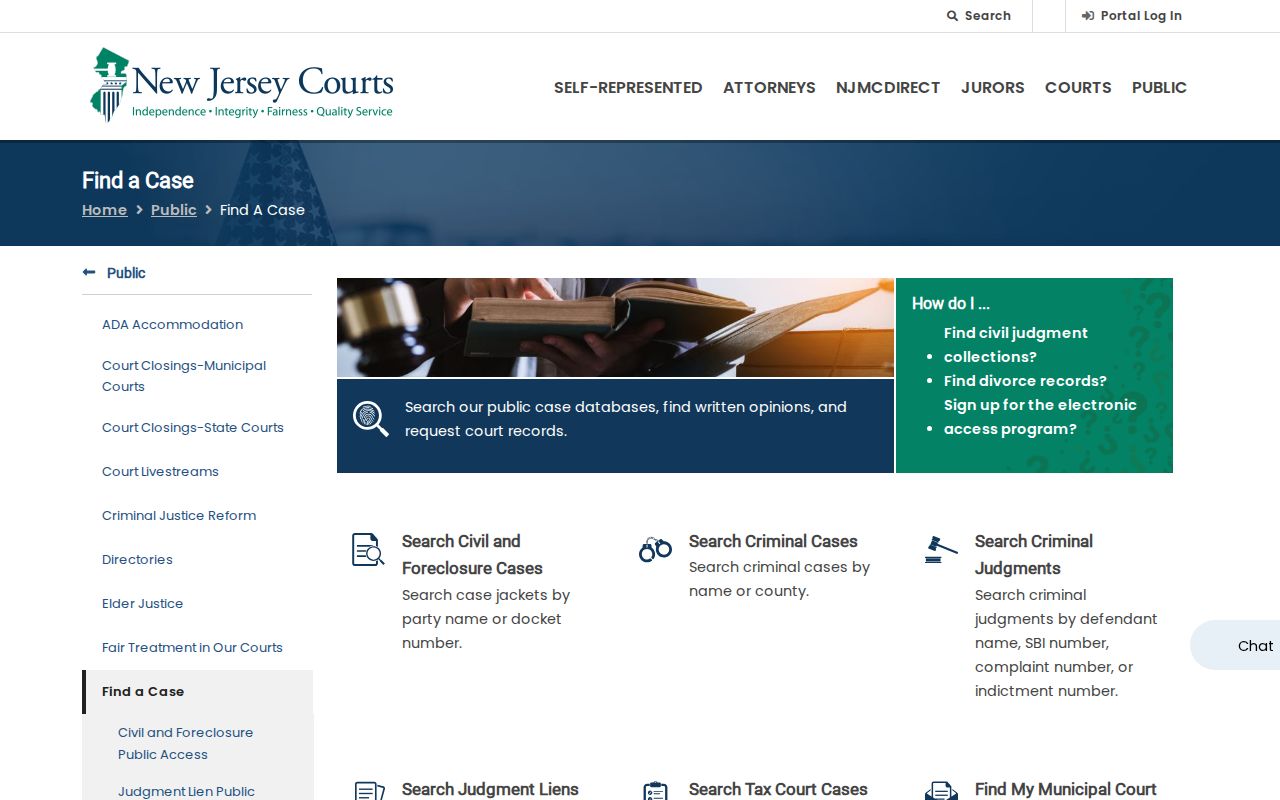
New Jersey Courts public case search separates docket-number, party-name, and judgment search modes. The civil case-jacket training material identifies an Individual or Business choice for party-name searching. For a Bayonne Superior Court matter, select Hudson as the county when that control is available. The public interface is a case research tool, not a complete criminal-history source or a proof of current residence.
| Field Label | Type | Required | Options or Format Notes |
|---|---|---|---|
| Search by Docket Number | Mode | No | Docket-number search mode |
| Search by Party Name | Mode | No | Individual or Business |
| Search by Judgment | Mode | No | Judgment search mode |
| Individual Last and First | Text | Yes in individual mode | Two characters or fewer search exactly; three or more can broaden |
| MI | Text | Optional | Middle initial |
| Case Division and County | Dropdown | Optional or conditional | Select Hudson for a Bayonne Superior Court matter |
| Docket Type, Number, and Year | Dropdown and text | Optional or conditional | Use together in the docket search mode |
The official court-search screen is shown below. It leads to the public case-search choices, while a full file or restricted material can require the Hudson Vicinage clerk or public-access terminal.
Search results and record availability depend on the case type. Bayonne Municipal Court has its own local route for dispositions, while federal matters are searched through PACER.
Checking Bayonne Resident Record Results
The court training sample displays the shape of a result without supplying a Bayonne case. Result-list columns include Name, Venue, Docket Number, Case Caption, and Case Initiation Date. Selecting a docket opens the case jacket, which can show more context. Treat the training display as an inventory of fields, not as a sample Bayonne resident.
| Caption and court | Identifies the case title and court that handled it. |
|---|---|
| Initiation date | Shows when the displayed case began, which helps separate same-name results. |
| Type and status | Describes the case category and whether the jacket shows an open or disposed matter. |
| Disposition date | Can appear with the outcome status when the jacket makes it public. |
| Judge, track, demand, or lien | May appear in a jacket detail view, depending on case and access rules. |
Sealed, juvenile, family, and other protected matters must not be treated as public name-search information. For papers, certified copies, or archived material, ask the Hudson Vicinage clerk for the current process and fee. Bayonne Municipal Court's record-request form is specifically a request for a disposition, not an automatic copy of every case paper.
Bayonne Voter Record Checks
The official New Jersey voter endpoint is a confirmation route for registration status. It is not a complete Bayonne household roll. State guidance recommends trying exact spelling variants, including hyphens, spaces, middle initials, and married names. A displayed registration may include name, residence or mailing address, party affiliation, status, registration date, county or municipality, ward or district, and limited participation data, depending on the access channel.
Ballot choices are not public through this route. Signatures, Social Security numbers, and driver or non-driver ID numbers are protected. Election-record requests have special treatment under N.J.S.A. 47:1A-5.3, alongside the voter statutes. Hudson election officials can explain whether a defined request belongs with an election custodian, a statutory voter-list process, or OPRA.
Inactive status is not proof that a person permanently moved. State guidance describes address questions and confirmation-mail evidence as part of maintenance, and a voter can reactivate by responding, appearing, or updating a record.
Bayonne Vital Record Limits
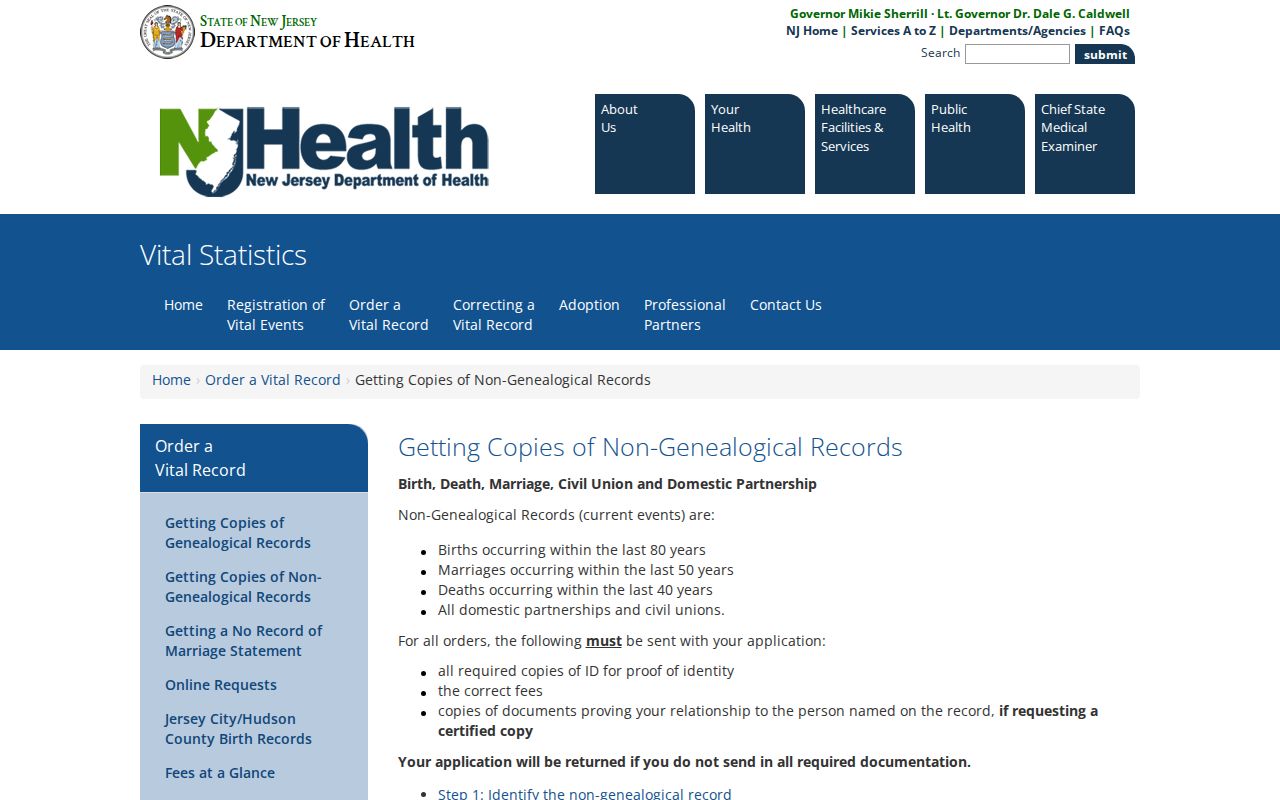
Vital records are not an unrestricted name database. For current non-genealogical records, NJDOH identifies birth records younger than 80 years, marriages younger than 50 years, deaths younger than 40 years, and all domestic partnership and civil-union records as restricted. A requester may need qualifying relationship or legal authority, identity documentation, and event details. The State Archives holds older birth records through 1924 and marriage and death records through 1950, subject to the record-specific route.
The NJDOH vital-record ordering instructions show the requested identifying fields, proof, and submission options. They list online processing, mail, walk-in state office, and local registrar routes. The displayed state charge is $25 for an initial certified copy or no-record result, plus $2 for each additional copy in the same order; genealogical searches have separately listed charges. Timing differs among NJDOH pages, so confirm the current channel before ordering.
For a Bayonne event, the local registrar or City Clerk can be the municipal starting point, but current eligibility should be confirmed with the registrar or NJDOH. Adoption identifying information is confidential; the official adoption registry or confidential-intermediary route is the appropriate path, not a public name search.
Bayonne Affiliation Record Trails
Some questions concern a public affiliation rather than an address. The New Jersey DORES business search supports Business Name, Keyword Search, and Entity ID modes, with separate ordering for status reports, standing certificates, and entity documents. A registered agent or filing address is an affiliation clue, not a residence.
MyLicense verification offers public professional and business verification. Its business route presents Profession, License Type, Business Name, License Number, and City fields, and requires at least two characters for a selected text option. For a former classmate, Bayonne Library yearbooks, the Alumni Directory listed by Bayonne History, oral histories, and newspapers provide historical evidence that can then be cross-checked with a dated directory or obituary.
For an heir question, begin with the obituary or newspaper, then move to the Surrogate's estate record. Hudson County estate records before February 22, 1840 route to Bergen County because Hudson had not yet been created. An estate address or executor name is a record lead, not an instruction to infer anyone's present location.
Bayonne Privacy and Lookup Limits
New Jersey's Address Confidentiality Program supplies a legal substitute address and mail forwarding for eligible participants. Daniel's Law directs redaction of residential addresses and unpublished telephone numbers for covered people and immediate household family members after approval. NJGIN expressly flags protected owner names. A redacted or missing result can be the intended privacy outcome, not a defect to work around.
The DCA Office of Information Privacy reported more than 10,000 covered persons protected by Daniel's Law in 2025. ACP, Daniel's Law, voter redactions, the Driver's Privacy Protection Act, sealed or expunged cases, and vital-record rules remain in force when a record is requested through OPRA. OPRA can support a written request for a public, non-exempt record, but it does not override confidentiality statutes. Ask the custodian for a segregable redacted copy where that is appropriate.
Lawful use. Use Bayonne resident lookup information only for personal, lawful research. Do not use a name, address, or record detail to stalk, harass, intimidate, or harm another person.
New Jersey's stalking law, N.J.S.A. 2C:12-10, addresses repeated conduct that causes reasonable fear in the circumstances described by the statute. Keep research focused on family history, an estate, civic records, or a documented personal connection, and stop when access rules or a privacy protection close the trail.