
Follow a Bayonne Street by Address
A useful Bayonne street directory begins with one physical address and works outward through records that use the same parcel key. The municipal tax list can connect a street location to a block, lot, owner, mailing address, tax class, and assessment fields. That does not prove that the owner lives at the location. It supplies a record key. Parcel maps then help place the address among nearby lots, and the Hudson County Register can connect the parcel to a dated transaction.
Use each source for the claim it can support. The parcel layer establishes map context. The tax record identifies the titled owner as listed. A deed gives recorded parties and a date. A voter lookup, if a known person is being confirmed, is not a street-browse roster. Older address material is a historical snapshot, not a statement about a current household.
- Open the Bayonne Tax Assessment links and save the situs spelling, block, lot, and qualifier from the tax-list row.
- Search the same location in the statewide parcel explorer with the address, Hudson County, Bayonne, or block and lot. Compare the map result with the tax key.
- Pan the parcel map along the street, recording only the public situs and block-lot identifiers for additional parcels that need research.
- Use Hudson County AcclaimWeb to search Bayonne legal-description fields, then compare the current owner, document type, recording date, and instrument or book/page details.
- For a dated household question, use a known name in the state voter search only as registration confirmation, then pair old address findings with library directories or census reels.
Note: Keep the tax mailing address separate from the situs address, because a tax bill can be sent somewhere other than the Bayonne parcel.
- Parcel
- A mapped unit of land identified locally by its block, lot, and sometimes a qualifier.
- Situs address
- The physical Bayonne property location, distinct from the address used for tax correspondence.
- Legal description
- The recorded parcel wording or map reference that can remain useful when a street address changes.
- Criss-cross directory
- An address-first directory arrangement; a complete Bayonne run was not verified in the research sources.
Read a Bayonne Tax List
The city’s tax-list structure is the local starting point for a street search. A row can show block, lot, qualifier, account number, land and building description, class, owner name, owner street and city, property location, ZIP, assessment values, exemptions, deductions, taxes, and update year. The owner mailing address and property location are deliberately separate fields. A trust, company, estate, or out-of-town address can appear in the owner field without describing who is present at the property.
The Bayonne Tax Assessment page links the local tax-map and tax-list routes. Its captured view is shown here.
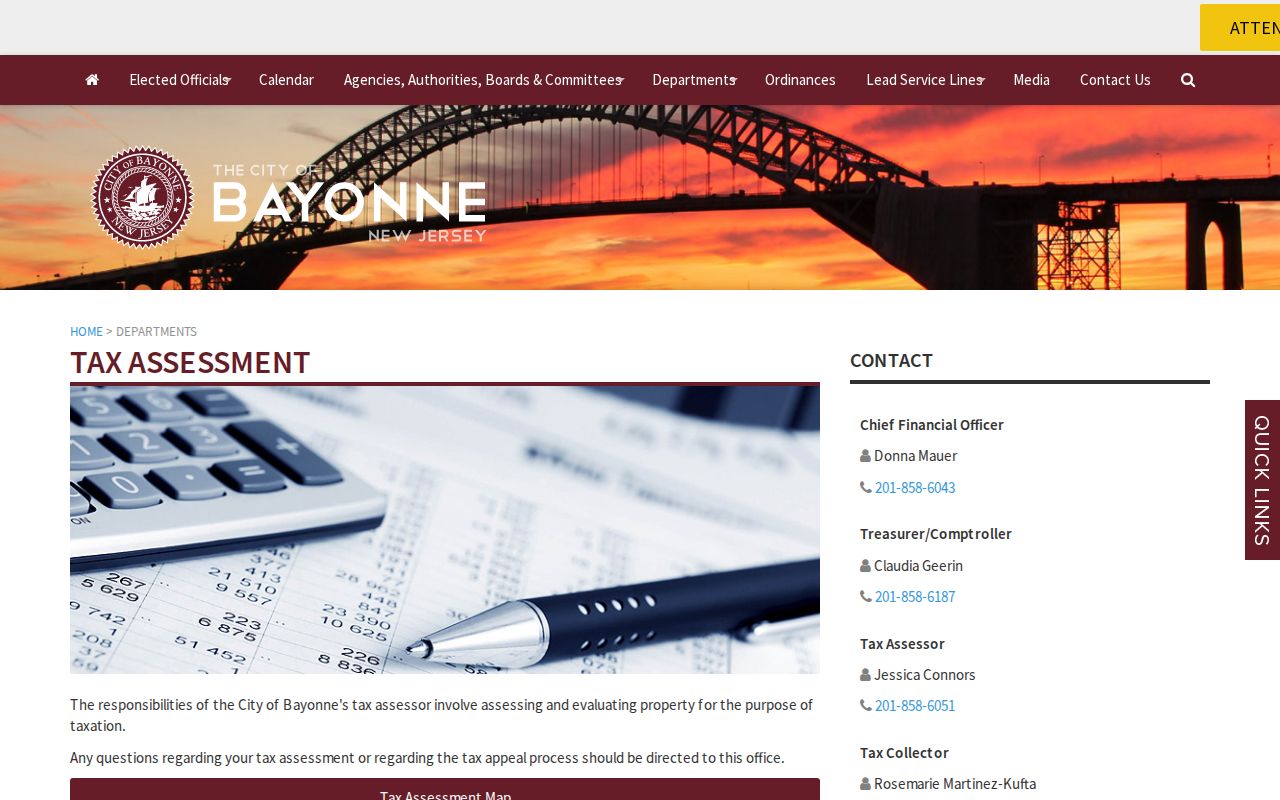
The page is a reliable route to the city’s assessment materials, but a separate live owner-name search was not located. Use the list and office contact rather than assuming a dynamic owner lookup exists.
Exemption codes and values are tax classifications. They are not a confirmation that a named person lives at the site. A tax-sale notice can also point to a block and lot, but it is a delinquency clue, not proof of the current title holder or the outcome of a sale.
Search Bayonne Parcels in NJGIN
The New Jersey Geographic Information Network Property Explorer offers the best documented public parcel-search fields for Bayonne. Start with the street address when it is known, then constrain the result to Hudson County and Bayonne. Block and lot are especially useful when a name has changed, a unit qualifier is involved, or a street abbreviation returns more than one result.
| Bayonne parcel field | Entry type | When to use it | Research note |
|---|---|---|---|
| Address | Text/autocomplete | Known situs | Try street-suffix variants. |
| County | Dropdown | Limit geography | Select Hudson County. |
| Municipality | Dropdown or text | Limit city result | Select Bayonne. |
| Block | Text | Tax-map key | Use the number from the tax list. |
| Lot | Text | Tax-map key | Pair it with the block. |
| Map layers | Map controls | Context check | Parcel, zoning, flood, or district availability varies. |
The NJGIN parcel gateway illustrates the statewide search and data-access route.
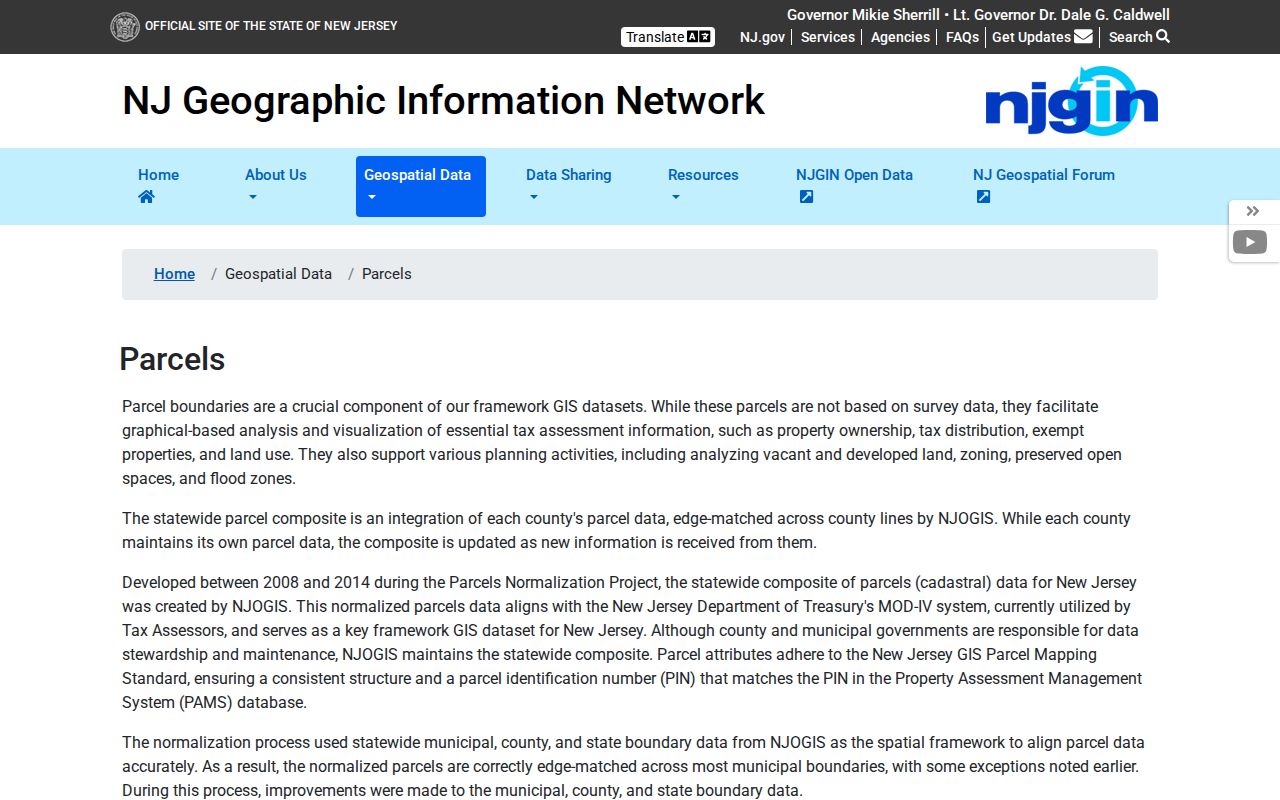
NJGIN warns that parcel geometry is not a survey or legal boundary. The data is maintained through county and municipal stewardship, and protected owner names can be redacted under Daniel’s Law. A map result should be checked against the current tax record and deed details.
Browse a Bayonne Street in Hudson GIS
A street-by-street review is map based. Locate the target parcel, verify its block and lot, then pan along the same segment and click nearby parcels one at a time. This gives a careful way to gather public parcel identifiers without turning a map view into a roster of everyone on the street. The captured source did not document a dedicated radius or nearby-parcel tool, so manual parcel review is the supported method.
The Hudson County GIS gateway is the county’s map route for that context.
Use any available parcel, zoning, flood, or district layer as map context. A parcel line does not settle a boundary question. The Register’s legal description and filed maps are the stronger record when an old subdivision, merger, or condominium qualifier complicates the street address.
Note: Dynamic Hudson GIS search labels and its complete live layer list were not captured, so confirm the current viewer controls before relying on a layer.
Use Hudson Deeds Along a Bayonne Street
Deeds make the Bayonne address trail more precise because the Register index is searchable beyond a party name. AcclaimWeb offers official-record, name, book/page, instrument-number, legal-description, document-type, consideration, and record-date modes. For an address trail, use Bayonne with block and lot or the property address in legal-description mode, then compare the name search. The legal description is safer than a street label when an address has changed or a parcel was reconfigured.
The Hudson County AcclaimWeb index shows the available search modes.
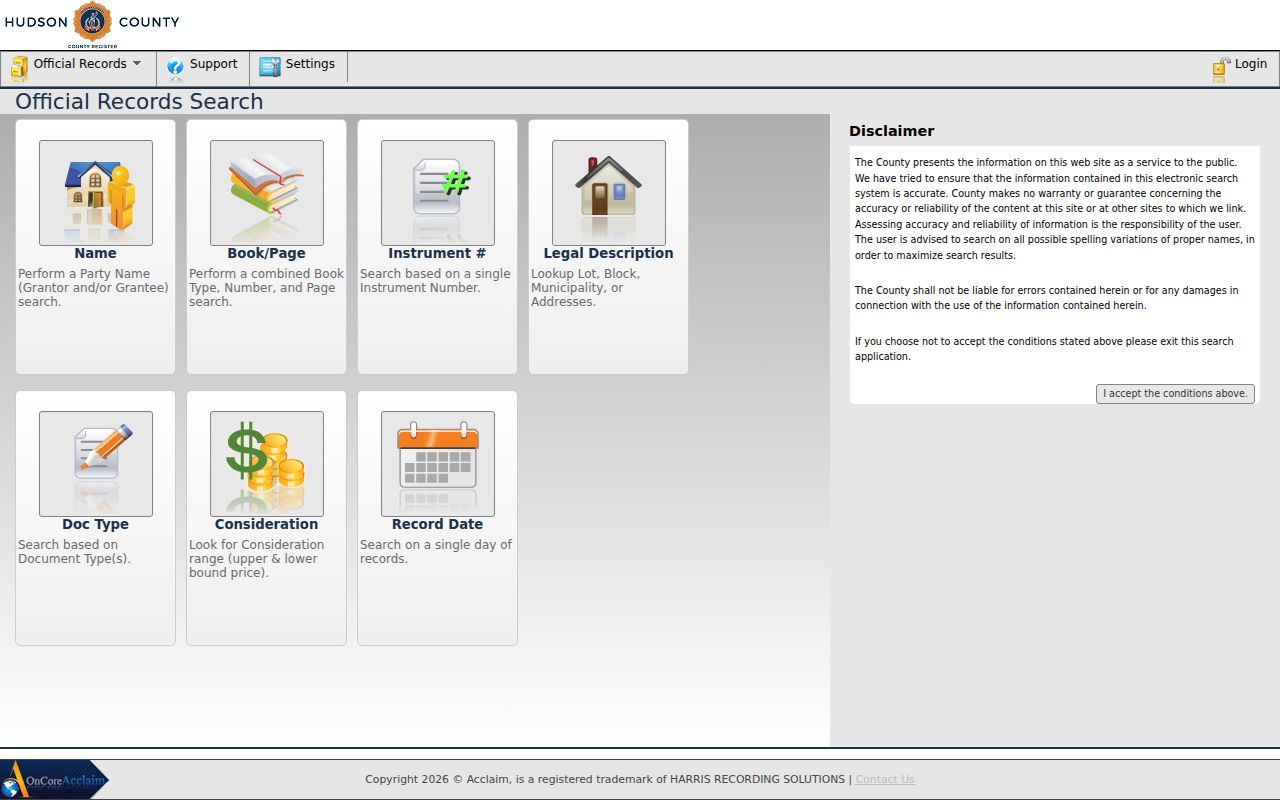
For each possible match, record the party role, document type, recording date, instrument number, book and page, legal description, and consideration. A mortgage, lien, or lis pendens is not a deed and should not be described as one. The county did not publish an official online index beginning year in the reviewed sources, so stop making online assumptions at the point the records stop and use the Register’s public search room.
Bayonne Street Records and Access
No one Bayonne street record answers every question. The city tax layer supplies parcel and titled-owner information. The map layers show geography. The Register documents recorded transactions. City departments may hold address-specific permit, zoning, fire, and resale material, while the library can help with historic occupants. The table separates those distinct claims and preserves the access route when an online index was not verified.
| Address-keyed source | Bayonne keeper | What the record can show | Access channel |
|---|---|---|---|
| Tax list | Tax Assessment Office | Owner, mailing and situs fields, block/lot, value, and class | City PDF, tax map, or office inquiry |
| Parcel map | NJGIN and Hudson GIS | Geometry, parcel identifiers, and available map layers | Public web map |
| Recorded documents | Hudson County Register | Parties, date, instrument, book/page, and legal description | AcclaimWeb or public search room |
| Building and resale files | Bayonne Building Department | Address, work or inspection timing, and named record parties | Defined address request or counter |
| Zoning or fire material | Planning/Zoning or Fire Prevention | Application, review, permit, inspection, or complaint context | Office or defined records request |
| Historic directories | Bayonne Library and related collections | Dated address and household notation | Reference desk, microfilm, or verified scans |
The voter endpoint is useful only after a person is already known. Exact-name variants matter, and the source material did not verify public street-browse fields or a complete street file. Hudson election officials can clarify whether a narrowly defined election-record request belongs with their office or under OPRA, subject to the statutory redactions that protect signatures and identification numbers.
Bayonne Avenue and 33rd Street
Address history matters in a Bayonne street directory because the city history identifies Bayonne Avenue as today’s 33rd Street. Older sources can also use Bergen Point, Constable Hook, Centerville, Pamrapo, or Saltersville as place names. Search the old and current wording beside the block and lot rather than treating a failed modern-address search as proof that the parcel was absent.
A complete citywide renumbering or renaming schedule was not located. For that reason, preserve the spelling from each deed, directory, tax list, or map and compare the legal description. Filed maps and earlier block-lot references are useful bridges where a street number alone produces a break in the chain.
Note: Bayonne’s place names are search terms, not interchangeable legal descriptions, so verify the parcel key before connecting records from different eras.
Bayonne Resale Certificate Records
Address research has a recent vocabulary change. Bayonne renamed continuing certificates of occupancy as Resale Certificates effective October 1, 2025, and resale inspections replaced CCO inspections. An older file may still be indexed or described with CCO or self-certification language. A current request for a defined address and date range should use both terms so the request is not narrowed by the newer label.
The Bayonne Building Department handles construction permits, plan review, and inspections. No public searchable city permit or code-case index was located in the research. For historic address material, ask the department or the appropriate city custodian what identifier and date range are needed, then make a narrow written request if the record is public and non-exempt.
Historical Bayonne Street Directories
Historic directories add the household layer that property records do not provide. Bayonne Library holds city-directory and census materials, while verified scans exist for 1918 and 1922–23. Directory notation such as “h,” “r,” or “wid” must be read in context. “H” means home or residence in the directory convention, not ownership. A reverse or criss-cross directory may arrange material by address, but a complete Bayonne reverse run was not verified.
For a former occupant, record the exact year, page, name spelling, street form, and notation. Then compare a nearby directory year with a census reel or recorded deed date. The historical volumes themselves and their cataloged years are covered on the Bayonne city directory page; here, the key point is that an address entry is a dated observation, not a current claim.
Older directories often abbreviate Avenue as “Av” and may use “do” for the same address as the prior entry. Search address variants before deciding a street trail has ended.
Limits of a Bayonne Street Directory
A street directory can identify records connected to a property, but it cannot reveal every person at that location. Tax records generally name a legal owner, not all occupants. A recorded transaction can name a buyer, seller, estate, lender, or other document party. Voter search is not a public household roster. Utility customer information was not located as a public Bayonne source, and motor-vehicle personal information is restricted by federal law.
New Jersey protections also change what may appear. The Address Confidentiality Program uses a substitute address for eligible participants, and Daniel’s Law can require government redaction of protected residential information. NJGIN specifically notes protected-owner redaction. An omitted name can be an intentional privacy result. Do not use spelling variants, old records, or map clues to reconstruct a redacted address.
Lawful use. Use Bayonne address records for family history, property research, civic questions, or personal curiosity. Do not use a record trail to follow, intimidate, contact, or harass a living person.
Note: An intentionally redacted record is not an invitation to reconstruct protected information through older parcel, directory, or map sources.
Bayonne Street Research at the Counter
When the web route stops, the record custodian is part of the street-directory process. The Hudson County Register’s public search room provides deeds, mortgages, lis pendens, filed maps, and indexes. It is at 257 Cornelison Avenue, second floor, Jersey City. Bayonne’s Tax Assessment Office is at City Hall, and the Library reference desk can check its finding aid before a researcher assumes that a directory, map, or clipping is digitized.
For county-held material, the Hudson County OPRA form is a written-request path, not a request for all information about an address. New Jersey OPRA requires a request to the correct custodian and does not override confidentiality rules. Describe the street address, block and lot, record type, and date range as narrowly as possible. If a copy fee or special-service charge matters, obtain the current quote from the office because the reviewed sources did not establish a full fee schedule.