
Bayonne Previous Residents by Era
The strongest past-household trail uses sources in date order. Begin with the current parcel because block, lot, and legal description hold the chain together when the street name shifts. Then use the Hudson County deed index for transaction parties, historic directories for dated household listings, census reels for household detail, and local history collections for maps, obituaries, and clippings. Each result needs a date and source label. A property owner, a directory household, and a census household may overlap, but they are not automatically the same finding.
| Bayonne source | Verified era | Where held | What it can establish |
|---|---|---|---|
| Tax list | 2022 verified; 2023 linked | Bayonne Tax Assessment | Block/lot, owner, mailing and situs fields, value, and tax data |
| Hudson deed index | Online beginning year not located | AcclaimWeb and Register search room | Grantor/grantee, instrument, book/page, date, and legal description |
| City directories | 1879–80 through cataloged 1951 runs | Library, State Library, and DigiFind-It | Dated address and household notation |
| Telephone directories | 1930, 1945–46, and 1947–47 listed | Bayonne History and library lead | Subscriber or business leads; address fields vary |
| New Jersey census | Bayonne reels from 1870 through 1915 | Bayonne Library microfilm | Household, age, and ward or address context |
| Federal census | 1920 and 1930 local reels | Library and federal census systems | Household composition and relationship details |
| Sanborn map | 1898 verified | Library of Congress | Structure footprint, use, stories, and material context |
| Obituary or probate | Obituaries 1960–2002; probate range varies | Library databases and Hudson Surrogate | Death, relatives, executor, heirs, and estate dates |
Start with the era that is closest to the address question. The tax and deed trail is the current anchor. For an older household, the directory-and-census pairing is often a better first route. The Hudson Register’s online cutoff year was not found in official sources, so older deed work may require the public search room rather than a web-only search.
Start With a Bayonne Block and Lot
Today’s street address is only the opening label for a past-residents search. The Bayonne Tax Assessment material identifies a property location, its block and lot, and separate owner-mailing fields. Keep the exact tax-list spelling and any qualifier. A condominium, merged lot, or older map can make the parcel key more dependable than a street number alone.
Next, check the address or block and lot in NJGIN Property Explorer or Hudson GIS. The map supplies geometry and a second check on municipality and parcel context. It is not a survey or a legal boundary. If a map display redacts an owner under Daniel’s Law, treat that as an intentional protection and do not try to rebuild the missing address from older sources.
Note: A mailing address on a tax record can be a tax-bill destination and may not be the address of a person connected to the Bayonne parcel.
Hudson Deeds for Bayonne Previous Residents
The deed chain is the ordered backbone when the question involves ownership. Use the current owner and legal description from the tax or GIS layer, then search the same Bayonne parcel in the Register’s legal-description mode. AcclaimWeb supports name, book/page, instrument number, legal description, document type, consideration, and record-date searches. Compare the document before moving backward. A transaction record names its parties; it does not, by itself, prove who made a home at the address.
- Save the Bayonne situs, block, lot, qualifier, current tax owner, and any legal-description wording.
- Search the current owner as grantee in Hudson County AcclaimWeb, then compare the matching parcel, document type, date, instrument, and book/page.
- Read the matched deed for the grantor, or seller, and the legal description. Record the transaction date rather than relying on the index title alone.
- Search that seller as a grantee to locate the earlier purchase, checking spelling variants, trusts, estates, and business names only as supported variants.
- Repeat backward. When online coverage stops, move to the Hudson County Register public search room for deed books, filed maps, and indexes.
- Grantor and grantee
- The grantor transfers an interest; the grantee receives it in the recorded document.
- Chain of title
- The sequence of recorded transfers for a parcel, read from one transaction back to the prior one.
- Legal description
- The parcel wording, block and lot, or map reference used to identify land more precisely than a street address.
- Criss-cross directory
- An address-first directory arrangement. A complete Bayonne run was not verified, so use only a volume whose format is visible.
Read the Bayonne Deed Index
A deed index is a finding tool, not a title opinion. The Register recommends spelling variations, and the index may lead to a party name, document type, recording date, instrument number, book and page, legal-description fields, consideration, and an image or document-detail link. Confirm the image, book/page, and legal description before connecting a record to a Bayonne address. A mortgage, lien, lis pendens, or map can involve the same property without being a transfer of ownership.
The Hudson County AcclaimWeb page shows its official-record and deed-search modes.
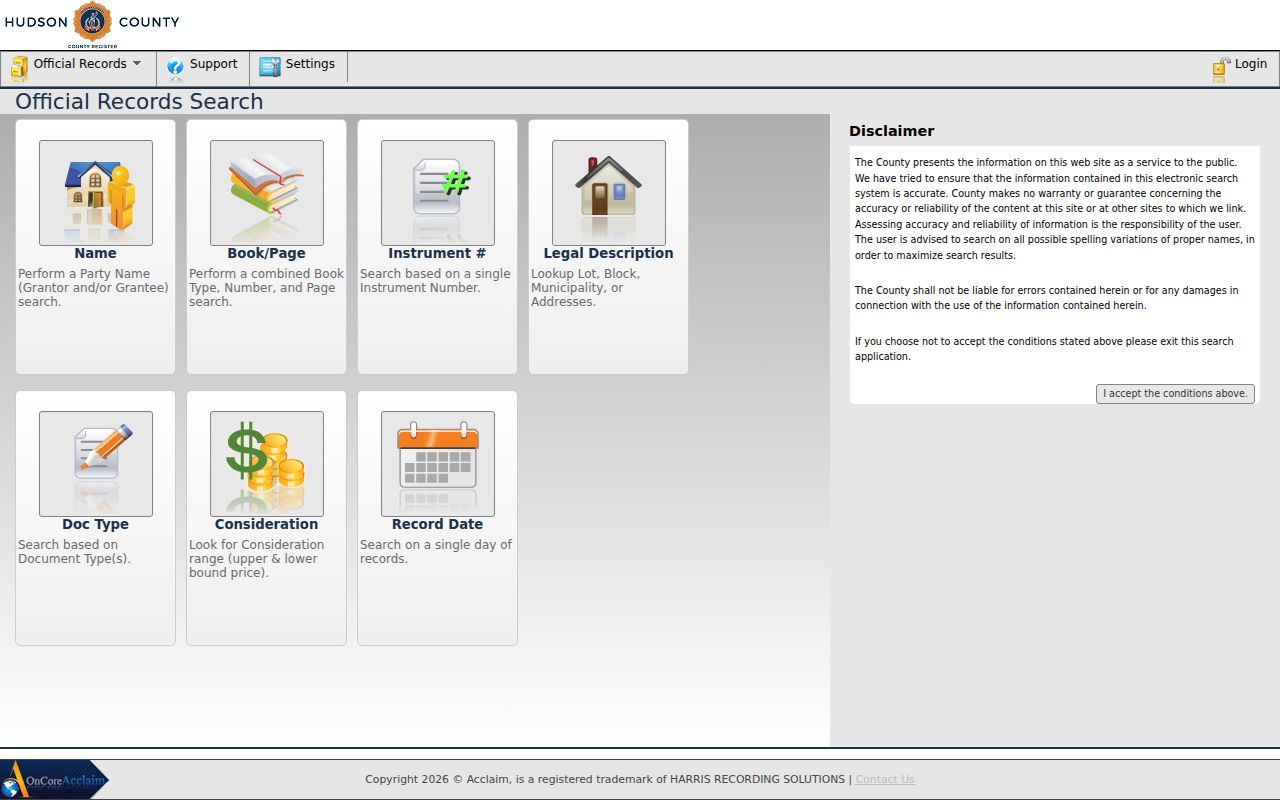
The County Register also maintains a public search room with deeds, mortgages, lis pendens, filed maps, and indexes. Exact search-room hours and the full copy-fee schedule were not located in the reviewed sources, so confirm both with the office before a visit or copy request.
Note: Record each document’s type and parcel description, because an index result with the same name can concern a different Bayonne property.
Bayonne Directory Years, 1879 to 1951
Bayonne’s verified directory spine is unusually long. The State Library catalog identifies a General Directory and Manual for 1879–80, then cataloged Webb, Allen, Moutier & Wand, Wand, Parker, General Directories, a 1938 classified business directory and street guide, and a Price & Lee directory for 1951. This gives past-residents research dated waypoints rather than a promise of uninterrupted annual coverage. The actual cataloged run has gaps, and a final printed year was not located.
The Bayonne Library Reference page lists city directories alongside maps, photographs, postcards, obituaries, oral history, and military history.
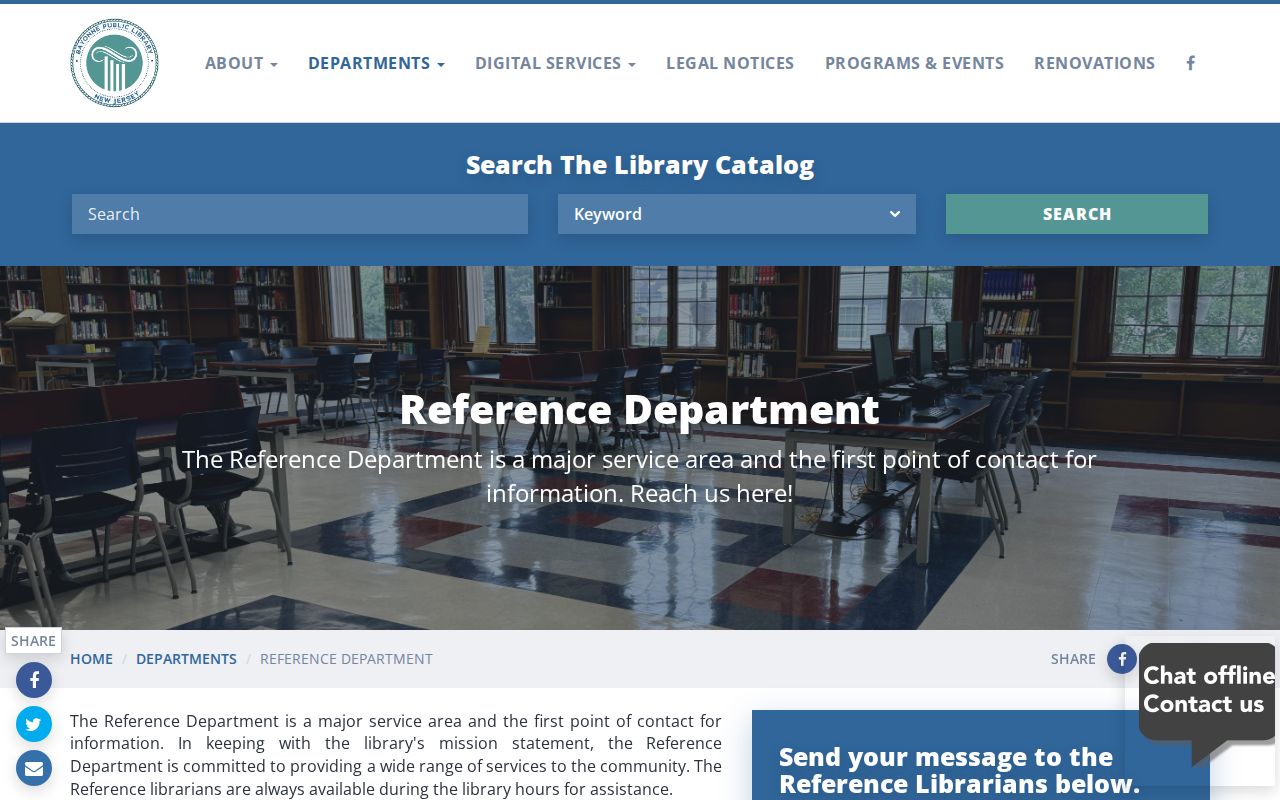
The reference desk is the right starting point for a specific address or year because archives are non-circulating and a finding aid is available there. The 1918 and 1922–23 directory scans are verified online, but physical or microfilm collections remain important for other cataloged years.
Pair Bayonne Past Residents With Census
Past households are found by pairing one dated address source with the nearest census snapshot. Start with the directory’s exact street spelling, house number, name form, page, and notation. Bayonne Library has local New Jersey census microfilm for 1870, 1880, 1885, 1895, 1900, 1905, 1910, and 1915, plus local 1920 and 1930 federal reels. The two sources should corroborate, not be forced to match. A directory was compiled at one moment and a census reflects its own enumeration date.
- Find the address or surname in a dated directory and note every visible abbreviation without expanding it beyond the printed key.
- Choose the closest available state or federal census year and use the library reel or in-library database route.
- Compare the street or ward, household names, relationships, ages, and other dated context, preserving conflicts rather than smoothing them out.
- Check an adjacent directory year before treating a missing name as a move, death, or ownership change.
- Use the deed date to distinguish a household listing from a property transfer, then record the sources in time order.
The directory collections, their publishers, and how to read a single entry are covered on the Bayonne city directory page. For previous residents, the value is the date bridge between a parcel transfer and the household evidence nearby in time.
Use 1898 Bayonne Maps as Context
The Library of Congress 1898 Sanborn volume is a structure check, not a people list. The verified Hudson County volume has 129 sheets and includes Bayonne as a secondary location. It can help establish whether a structure or lot existed and how it was described in that period, including building footprint, use, number of stories, and material context.
Use the map beside the deed’s legal description and the directory’s address wording. Later Bayonne Sanborn years were not located in the official research sources. A map match does not prove that the same street number, use, or household remained unchanged after the map date.
Bayonne Avenue Becomes 33rd Street
Old place names can interrupt a previous-residents search even when the parcel trail is sound. Bayonne’s city history identifies Bayonne Avenue as today’s 33rd Street, and older materials may refer to Bergen Point, Constable Hook, Centerville, Pamrapo, or Saltersville. Search both the historical and current forms with the block and lot, directory year, or map context.
A full municipal renumbering schedule was not located. Preserve the wording from the original source and use legal descriptions and filed maps to make the connection. Do not assume that a modern street-number search captures all older variants.
Note: An old street form is a research lead, not proof that two similarly named addresses describe the same parcel.
Bayonne House Research Records
There is no verified standalone Bayonne guide for researching one house. The proven local route is the Library reference desk and its non-circulating archives, which include directories, maps, photos, postcards, census microfilm, yearbooks, newspaper material, and vertical files. Ask for the finding aid before assuming an item is digitized, and bring the exact address forms, parcel key, date range, and names already found in the deed chain.
Bayonne History’s research holdings include city and telephone directories, yearbooks, books, and genealogy material.
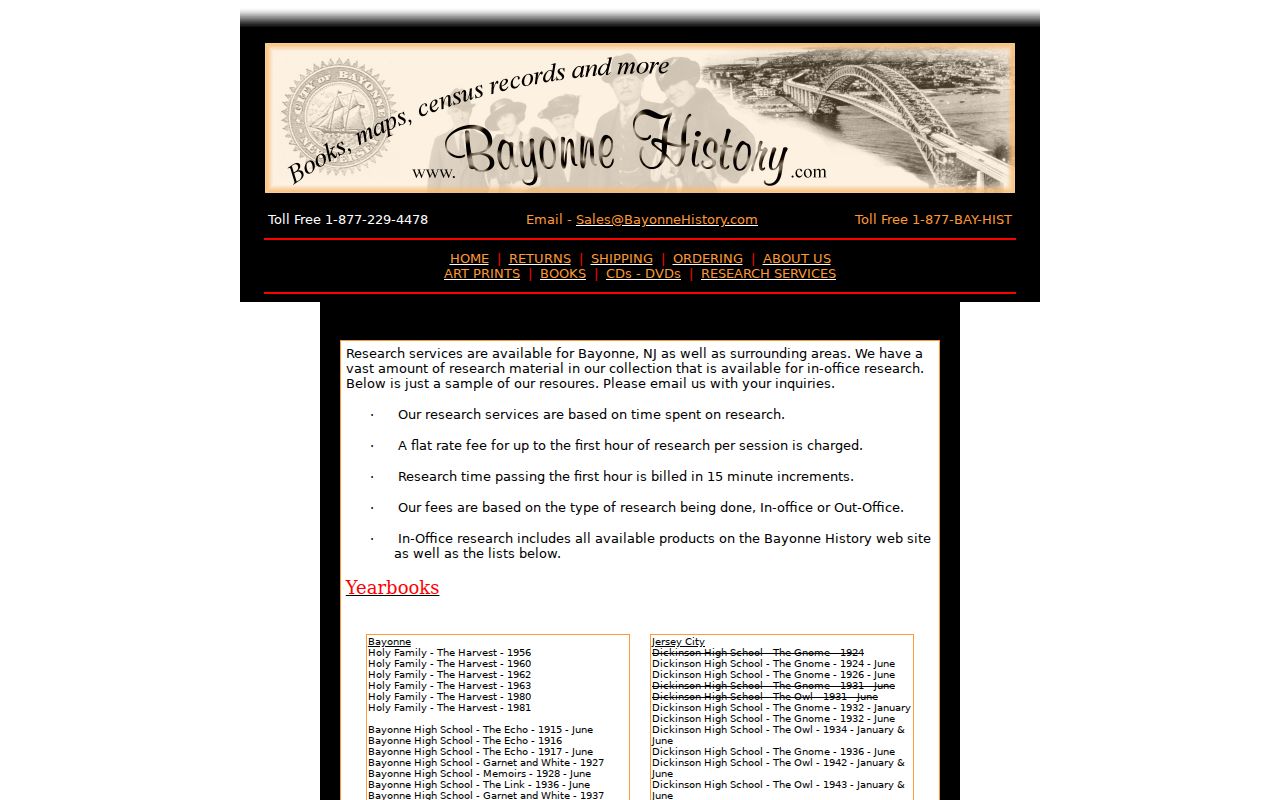
Bayonne History offers independent research and is not affiliated with the city or historical society. Its listed telephone-directory leads include 1930, 1945–46, and 1947–47 as cataloged. Request a current quote and ask about the particular address or year rather than assuming a complete address-first directory run exists.
Note: Independent holdings can provide a useful lead, but confirm the volume, date, and source location before connecting it to a parcel trail.
Bayonne Estate and Obituary Endpoints
When a deed trail reaches a death or estate transfer, the library and Surrogate add a different kind of evidence. Bayonne Library’s digitized resident obituaries cover 1960–2002, with more years planned, and its databases provide broader obituary and newspaper routes subject to their access limits. An obituary can supply relatives, a funeral location, or a last-residence detail, but it is a dated family-written source that should be corroborated.
Hudson County Surrogate records include wills, administration papers, guardianship material, accounts, bonds, dockets, and estate papers. They can identify an executor, heirs, or estate dates. For estate research before Hudson County’s February 22, 1840 creation, the jurisdiction is Bergen County. An estate address or heir reference is a record lead, not evidence of anyone’s present location.
Limits on Bayonne Previous Residents Research
Previous residents are not a single official list. A tax owner can differ from a directory household, and an old directory or census result is not a current-address record. The Register’s public index does not publish a verified online start year, the city did not publish a complete reverse-directory run, and no full Bayonne renumbering table was located. State and county privacy rules may also leave a current record redacted.
New Jersey’s Address Confidentiality Program and Daniel’s Law protect certain residential information. OPRA can request public, non-exempt records from the correct custodian, but it does not override those statutes, protected-victim information, sealed material, or redactions. Ask for a segregable redacted copy when appropriate and preserve the custodian’s response with the record trail.
Lawful use. Bayonne past-residents research supports house history, family history, estate research, and civic curiosity. Do not use an address trail to follow, intimidate, contact, or harass a living person.